Skip to content
Built for product & project owners

Ship more of your roadmap.
Without losing sight of a thing.

Syrus lets product, project, and application owners put AI to work from goal to merged pull request — turning conversations into tracked epics and tickets, running many changes on your codebase at once, and keeping a human review on every merge. You ship more each sprint, you see exactly what's being built and what it cost, and the guardrails keep AI's speed from becoming AI's mess.

More shipped per sprintHuman review on every mergeEpics, tickets & cost, fully tracked
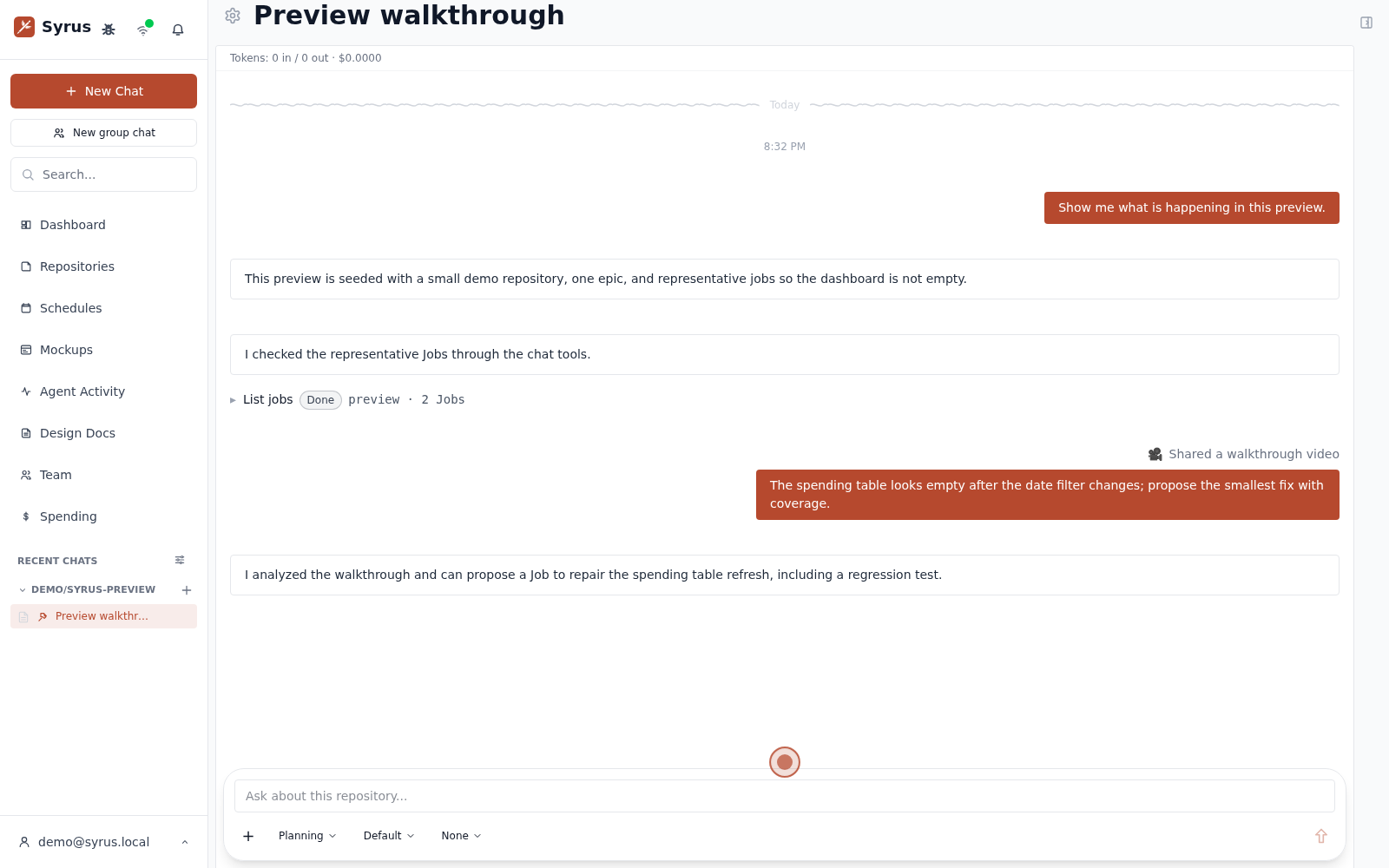
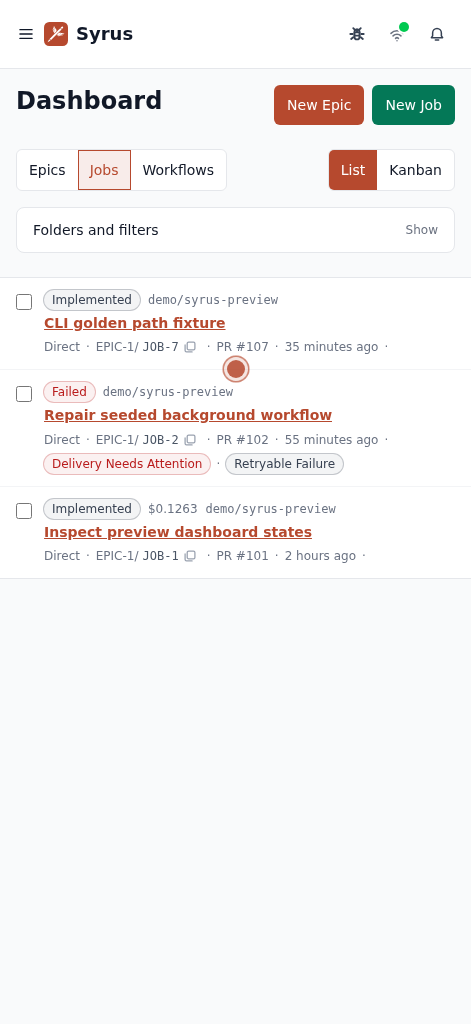
The Syrus app on mobile.

Bis dat qui cito dat. “He gives twice who gives quickly.” — Publilius Syrus

How your team works with Syrus

You steer it. Syrus builds it. Your team ships it.

Every goal turns into tracked epics and tickets, so you always see what's in progress, what's in review, and what shipped — and someone on your team signs off before anything merges, per the review policy you set.

You & your teamSyrus AIIn tandem
1
You & your team

Set the goal

Describe the outcome in a Syrus chat — a feature, a refactor, a whole initiative. Syrus reads your repositories and drafts the plan. Nothing becomes work until you confirm it.

2
Syrus AI

Proposes epics & tickets

Big goals become epics: dependency-ordered stacks of scoped tickets — “Jobs”, in Syrus — that your team can accept, edit, or reject before any code is written.

3
You & your team

Green-light the work

A developer releases the plan for execution — or triggers Syrus directly with a label on a GitHub issue, right where your code already lives.

4
Syrus AI

Writes the code

Clones, branches, and implements in an isolated workspace — many changes in flight at once, even on the same files — then opens a pull request with the diff and a step-by-step test plan. The full transcript stays on the job record.

5
In tandem

Review in tandem

Your own checks — tests, lint, typecheck — grade every change, and a red result sends the agent back before the PR even opens. Syrus answers review comments; your developer brings the judgment machines can't.

6
You & your team

Ship world-class code

Human approval gates the merge — self-review, two-person, or a designated final say: your policy. Once approved, Syrus lands it for you — rebased, re-checked on the exact branch, merged in dependency order. Branch protection, never bypassed.

Why Syrus

Leverage AI — with the control an owner needs.

More output, real guardrails, and full visibility into what's being built — so you can move faster without gambling on quality.

Multiply your output

Run many changes on one codebase at once — even changes that touch the same files. Every job works in its own isolated workspace, in-flight branches are rebased against each other automatically, and ordered work ships as stacked pull requests that land in sequence.

AI speed, without the AI mess

Your own checks — tests, lint, typecheck — grade every change, and a red result sends the agent back to fix it before a PR ever opens. Then human approval gates the merge, per the review policy you set. AI's velocity never turns into hallucinated logic slipping into production.

Approve it — it lands itself

After sign-off, the landing queue takes over: rebase, re-run your checks on the exact branch about to merge, then merge in dependency order. Epics land as one green unit or not at all — no half-merged features on your main branch.

See exactly what's being built

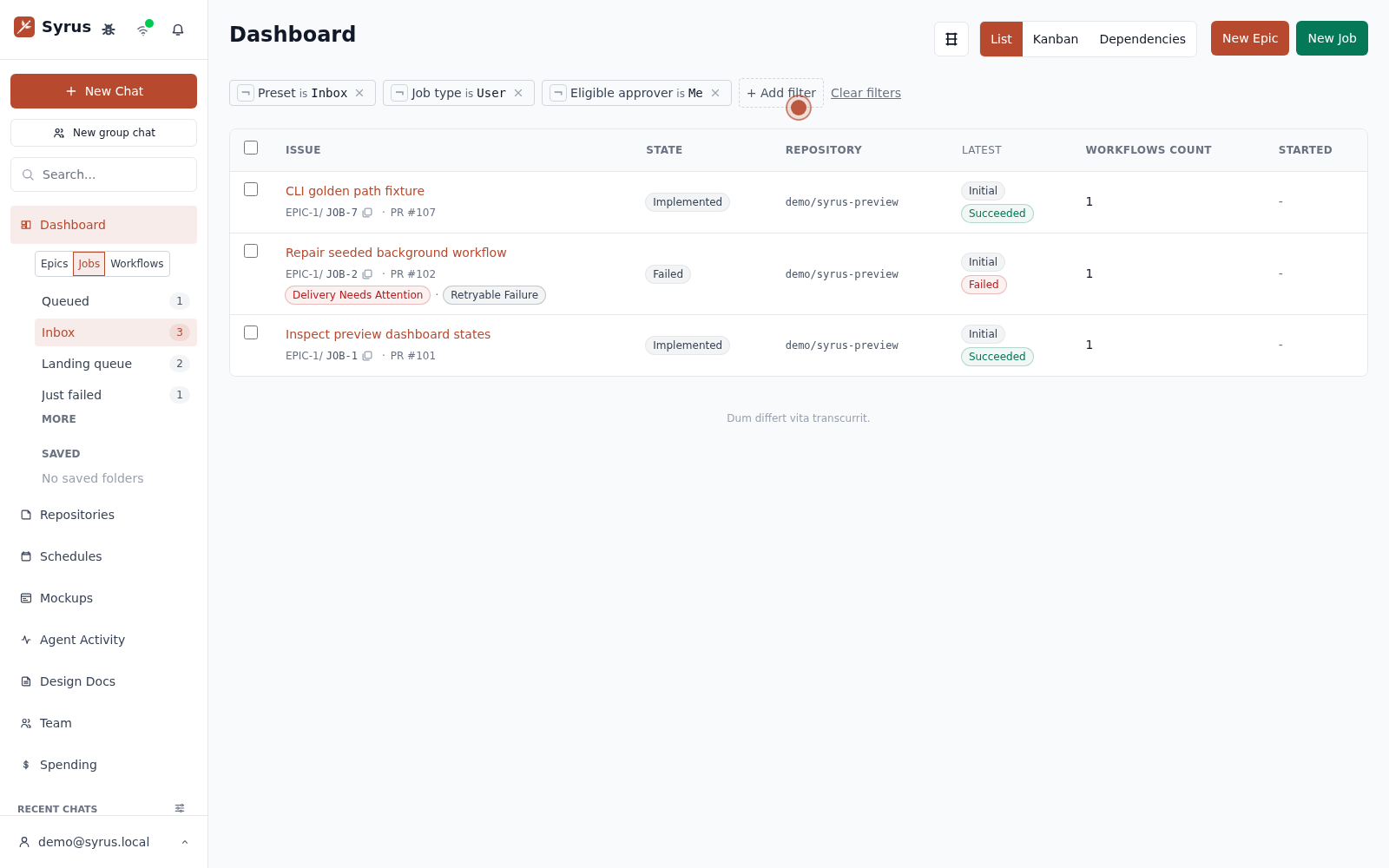
Goals become tracked epics and tickets, and every attempt keeps its full transcript, diff, and review — an append-only record of who asked for what and exactly what the agent did. Operational dashboards track queues, workers, and host pressure, while repository throughput metrics show PR creation, output, landing, and review flow without hiding sparse samples.

Know what every feature cost

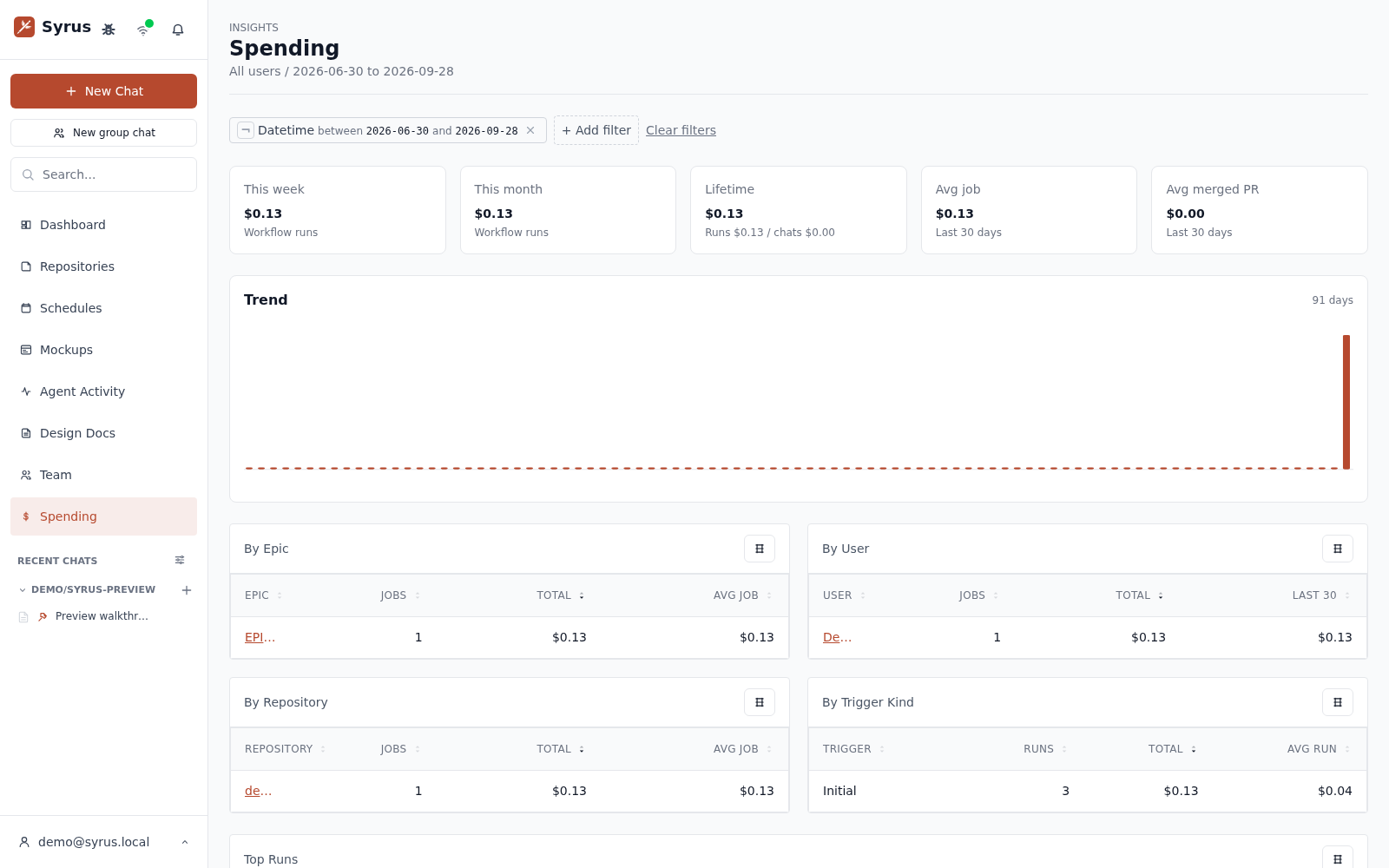
Every run records what it spent. A spending dashboard breaks AI cost down by epic, person, and repository — so you know what each feature actually cost to build, not just that it shipped.

Stay in control, on your terms

Self-hosted on your infrastructure, and your code goes only to the model provider you choose — Claude or Codex, on your own credentials. Syrus only ever calls out: no inbound webhooks, no public endpoint to expose. Your issues, reviews, and merges stay in GitHub.

Six ways in, one execution model

However work starts, it's tracked the same way.

A ticket, a review comment, a failing check, a scheduled chore — each becomes, or updates, the same tracked job, with every attempt on one timeline. Nothing happens off the books.

Issue or ticket

A labeled issue becomes a tracked job, a branch, and a pull request.

PR feedback

Your review comment triggers a follow-up commit on the same branch; teammates' comments queue for one-click apply.

CI failure

A failing check kicks off a bounded, automatic repair attempt.

Chat or direct prompt

A confirmed chat proposal or a direct prompt from your team, no ticket needed — chores, experiments, urgent work.

Scheduled task

Cron or one-shot runs for dependency chores, docs sweeps, hygiene.

Rebase

An unmergeable branch gets a deterministic rebase — the agent steps in only if judgment is needed.

See Syrus running on your roadmap.

Download the desktop app — it sets up a complete local Syrus (Docker included) or connects to your team's instance. Or request a guided demo and we'll show you how goals become tracked tickets, AI-written code, and reviewed pull requests, end to end.

Syrus is built with Syrus — every feature ships through its own pipeline.

  • More shipped each sprint, no new hires
  • Human review and approval on every change — your policy
  • Full transcript, diff, and cost record for every run
  • Self-hosted — one-command Docker install, Kubernetes when you scale

Request a demo

Tell us about your team

No spam. We only use this to arrange your demo.